
22 Mar Construction Gap Analysis: Finding Process Gaps
Construction projects rarely lose money because of one obvious problem.
More often, the problems build up in the background. A process takes longer than it should. Teams enter information twice. One department is waiting for another. Teams discover a quality issue after completing the work. Teams cannot find materials where they expect them. People develop workarounds because the formal process is too slow or difficult to use.
Individually, these problems may seem manageable. Together, they affect cost, programme, quality and productivity.
A construction gap analysis helps identify where those problems are occurring, why they are happening and what needs to change.
At Qualitaz, we look beyond what a procedures says should happen. We look at what actually happens in the operation.
What is a construction gap analysis?
A construction gap analysis is a structured review of the differences between the current state of an operation and the required or desired way of working.
This could relate to a single process, department, project or the wider business.
For example, a company’s procedure may state that a material request is raised through a specific system, reviewed, approved and then ordered.
But in practice, the team may be sending requests by email, following up by Whatsapp and maintaining a separate spreadsheet because the system is too slow or difficult to use.
The documented process exists.
The actual process is different.
That difference is the gap.
The purpose of a gap analysis is not simply to identify that the process is being bypassed. It is to understand why the gap exists.
For example:
- Is the process unclear?
- Does the system not support the way people work?
- Teams have not clearly defined responsibilities?
- Is information being lost between departments?
- Has the process evolved without anyone reviewing it?
- These are the questions that lead to meaningful improvement.
These are the questions that lead to meaningful construction process improvement.
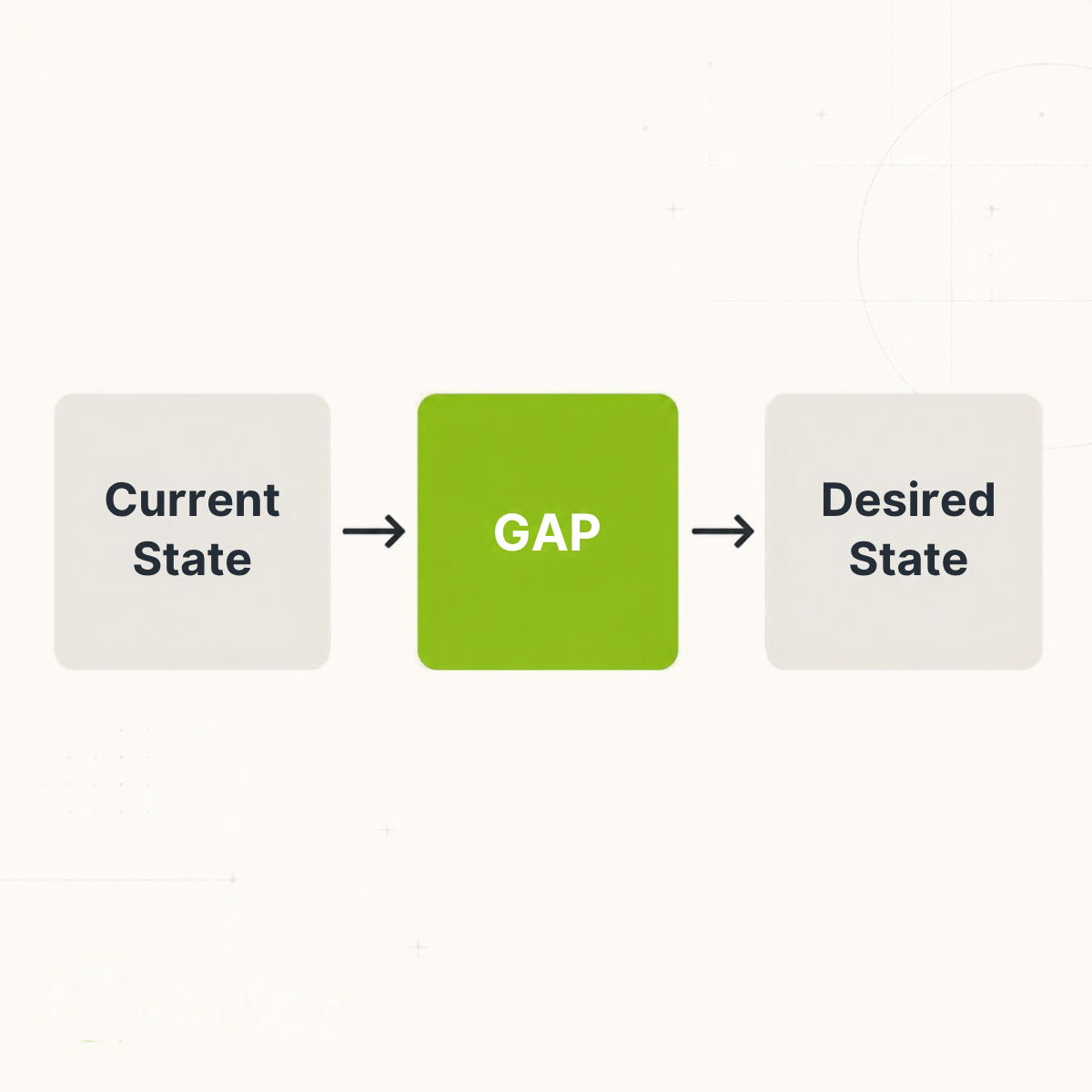
A construction gap analysis identifies the differences between how a process currently works and how it needs to work.
Why do operational gaps develop in construction?
Construction businesses are complex. Multiple departments, contractors, suppliers and project teams need to work together, often under significant programme and commercial pressure.
Operational gaps commonly develop when:
- Processes are designed in isolation
- A process may work well within one department but creates problems for the next department in the chain.
- For example, procurement may achieve its own target while site teams are left waiting for information or materials.
- Systems do not match the way people actually work
- A business may invest in new software, however, if the workflow is complicated or does not reflect what happens on site, people will find alternative ways of working. As a result may create spreadsheets, email chains or other workarounds.
Responsibilities are unclear
When ownership is not clear, tasks can be duplicated, missed or passed between teams.
This can create delays and make it difficult to establish where a problem actually started.
Information does not flow effectively
The same information may be entered several times, held in different locations or communicated differently to different people.
This increases the opportunity for errors and makes it harder for teams to work from the same information.
Teams identify problems too late
For example, a quality issue discovered during final inspection may be the result of a problem much earlier in the process.
By then, correcting it may involve rework, delay and additional cost.
What does a construction gap analysis look at?
The scope depends on the problem being investigated, but a meaningful operational review can examine.
Processes and workflows – how work moves from one stage to another
People and responsibilities – who does what and where ownership sits
Communication – how information moves between teams
Systems and technology – whether existing tools support the operation.
Quality controls – where checks take place and whether they prevent problems
Materials and information – how they are requested, controlled and tracked.
Handover – whether information and outstanding work are being managed progressively
The important point is that these areas are connected.
A quality problem may actually originate in planning.
A handover problem may begin with poor information control months earlier.
A material delay may be caused by an unclear approval process rather than procurement itself.
Looking only at the visible problem can mean missing the real cause.
What is the difference between the documented process and the real process?
This is one of the most important parts of a gap analysis.
Most businesses have procedures.
The question is whether those procedures reflect what people actually do.
Consider a typical construction inspection.
The formal process may require an inspection request, inspection, recording of the result and closure of any outstanding items.
In reality, the inspection may happen informally, records may be completed later, photographs may be stored separately, and the team may have to transfer the information into another system.
The procedure has not necessarily failed because people are unwilling to follow it.
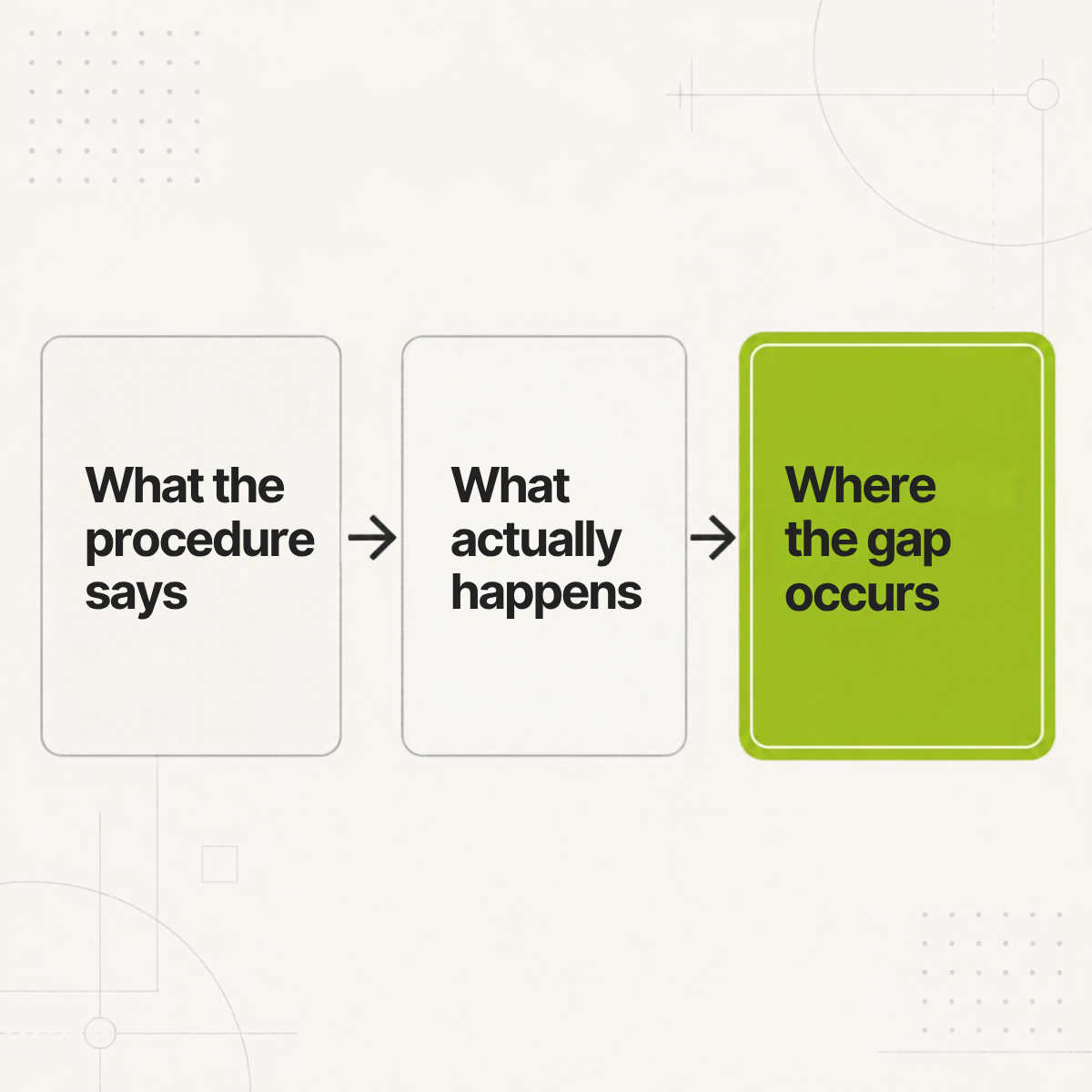
The gap between the documented process and what actually happens in practice can create inefficiency, rework and quality problems.
The process itself may be creating the problem.
This is why simply telling people to “follow the procedure” does not always solve the issue.
A gap analysis asks:
Why are people working around the process?
That question can reveal much more than an audit of whether the procedure has been followed.
What are the signs that a construction business has process gaps?
You may already be experiencing gaps without formally identifying them.
Common signs include:
- Teams constantly firefighting
- Managers spending time chasing information
- Multiple spreadsheets tracking the same information
- Different versions of documents being used.
- Repeated quality issues
- High levels of rework
- Materials difficult to locate or track
- Decisions being delayed because information is incomplete
- Procedures being routinely bypassed
- Inspections taking place too late
- Departments blaming each other for problems
- Handover becoming a last minute exercise
- Senior Management repeatedly resolving issues that should be controlled within the process.
None of these necessarily indicate that one person or department is at fault.
They can be symptoms of a wider operational problem.
The important question is not simply What is going wrong?
It is why does the process allow it to happen?
Why are construction quality problems often operational problems?
A defect is not always caused by poor workmanship
The underlying cause may be:
- Incorrect information
- poor sequencing
- inadequate supervision
- material control provision
- unclear responsibilities
- ineffective inspection points
- insufficient training
- communication breakdowns
- programme pressure
- a process that is difficult to follow
However, increasing inspections may identify more problems, but it does not necessarily prevent them. Instead, the better question is what allowed the problem to happen in the first place?
This is where operational improvement and quality improvement overlap.
In one Qualitaz project, a review of the wider process and quality controls helped reduce a defect rate from 8.6% to 0.3%.
The objective was not simply to find more defects.
It was to understand why they were occurring and change the process that was allowing them to occur.
How is a construction gap analysis carried out?
At Qualitaz, our approach is practical rather than purely document-based.
1.Understand
We establish how the operation is intended to work and how it currently works.
This can involve reviewing procedures, systems, records and documentation, as well as speaking with the people involved and observing the operation.
2. Identify
We identify gaps, inefficiencies, duplicated activities, communication failures, control weaknesses and recurring problems.
We also look at the relationship between them.
3. Improve
We determine what needs to change.
This may involve changing a workflow, clarifying responsibilities, improving information flow, introducing a control point, simpfying a process or making better use of an existing system.
The solution needs to work in the real operating environment.
4. Implement
A review only creates value when something changes.
Depending on the requirement, implementation may include process changes, training, workshops, controls, coaching or ongoing operational support.
We don’t just write reports. The objective is an improved operation.
When should a construction business carry out a gap analysis?
A construction gap analysis can be useful when a business is experiencing recurring problems but the underlying cause is unclear.
It may be appropriate when:
- Projects are experiencing repeated delays or rework
- Different teams are working in different ways
- Existing Procedures are routinely bypassed
- A new system is not being used as intended
- Quality problems continue despite additional inspections
- Handover is becoming increasingly difficult
- Management is spending too much time resolving operational issues
- The business is growing and existing processes are no longer working effectively
- A company is looking to improve productivity or reduce unnecessary cost.
The review does not always need to cover the whole business.
Starting with one department, process or recurring problem can often reveal where the wider issues are coming from.
What is the difference between a gap analysis and an audit?
An audit generally assesses whether defined requirements, procedures or standards are being met.
A construction gap analysis looks more broadly at the difference between the intended process and the way work is actually being carried out.
The two can complement each other.
An Audit may identify that a procedure has not been followed.
A gap analysis asks why it is not being followed and what needs to change to make the process work in practice.
This distinction is important when the objective is not simply compliance, but better performance.